Polyphagous shot-hole borer
Late in 2014 was when dozens of sycamore trees in UC Irvine’s Aldrich Park began to die. Several months later, they found that hundreds of cottonwoods, golden rain and coral trees were also dying. “We’ve seen infestations of pests, but nothing to this extent,” said Richard Demerjian, director of UCI’s Office of Environmental Planning and Sustainability. “It came as quite a shock.”
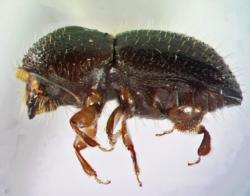
The polyphagous shot-hole borer (PSHB) is the insect that is causing these trees to die. This tiny beetle is smaller than a sesame seed. It is not native to the area and it has no natural predators.
The PSHB drills holes into trees and brings with it a pathogenic fungus (Fusarium euwallacea), as well as other fungal species. It creates galleries under the bark and plants the various fungi there. The fungi will then spread through the tree’s system and eventually kill it.
Researchers have identified 2,000 trees at the university that are infested and about 400 have already had to be cut down. Many other trees have had their main branches or entire tops cut off. Scientists, led by Akif Eskalen of UC Riverside, have now turned Aldrich Park into a giant outdoor research lab.
Eskalen has selected 130 sycamore trees for his experiment. He divided them into 13 groups of 10. Four of the groups were treated with various insecticides; three were treated with different fungicides; and four others got one of each.
One other group of trees was given a beneficial bacteria, found in some California trees, that they believe may kill the fungus. Last, they have one control group that received no treatment at all. Researchers have been monitoring these trees since last June. They will analyze their results this June and continue to monitor the trees for a few more years. Eskalen hopes to find a chemical or microbial weapon that will help to fight the infestation. The PSHB has spread through six counties in Southern California.
Here are some tree management tips from the scientists at UC Riverside:
- Protect your trees and local habitat from a variety of pest species by avoiding moving infected wood around. Use firewood locally!
- Although the PSHB has been found to attack healthy trees, they believe that keeping trees in optimal health is always a good defense strategy.
- Choose trees that are appropriate for the site and ones that don’t require a lot of water. Provide appropriate soils and access for roots to grow and expand.
- Avoid excess pruning. Sterilize pruning tools between uses to avoid spreading the fungus.
- Don’t under water trees.
- Don’t plant inappropriate companion plants within the tree’s dripline.
- If you think that the PSHB is affecting your trees, please call your local Agricultural Commissioner’s office.
Ladies and gentlemen, this problem with the PSHB is a big deal. Right now, there is a four-mile-wide willow forest in the Tijuana River Valley that has 140,000 severely damaged trees. We really need to cooperate with our researchers and Agricultural Commissioners to solve this problem or a picture of tomorrow’s California may present a radically different view.