
America’s redwood forests are under assault by tree poachers. These poachers are using chain saws to cut off burls, located at the base of trees, so they can sell them to wood dealers. These burls are prized by wood workers because of the wavy patterns in the wood.
A burl is a knobby growth most commonly seen at the base of some coastal redwoods, though it can also be found high in the canopy as well. Burls are attractive for making bowls, clocks, furniture and other natural wood products. Wood dealers are paying $2 to $3 per pound for burls which may weigh as much as several hundred pounds, each.
California’s redwood parks are home to the tallest trees on earth (as much as 379 feet high) and some are up to 2,000 years old.
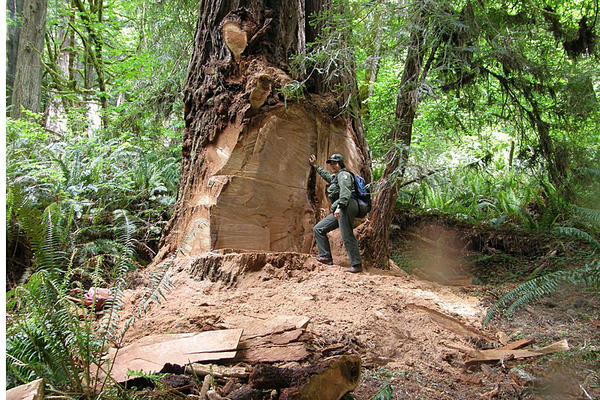
This is a picture of a redwood tree that has its burl removed.
Burls are crucial to the survival of the redwoods. When a burl is cut off, much of the bark is damaged or removed and that bark is critical to protecting the redwoods from infection and insects. The bark also protects the trees from fire because the material is flame resistant.
Burls also contain the trees’ dormant seed buds. In other words, if a tree dies after the burl is removed, it cannot follow its natural course and reproduce.
State park officials are limiting nighttime access to areas where they suspect tree poaching will occur. Managing the forest is difficult because we have 133,000 acres of public land with redwood giants. Prime locations for poachers are the desolate areas where there are few visitors, which makes it easy for them to work undetected.
Taking burls from a state park is a crime and their size determines whether the crime is a misdemeanor or a felony.
During the past 150 years, officials estimate that 95 percent of the original forest has been cut down. The only remaining old growth forest in existence is almost entirely within the Redwood National Park.
Termite Terry says, “If you haven’t ever been to our Redwood National Park, you really should make plans to see it. There are no words you can use to describe the magnificence of these giant trees. It is very important we protect what is left of this precious natural resource so our future generations can enjoy the spectacular beauty of these trees.”
